There is a particular kind of garment that ends up at the back of a closet rather than at a donation bin. It's usually leather. It was expensive, or it was inherited, or it was the single best thing on a vintage rail that day. It no longer fits, or the zipper gave out, or the length belongs to a different decade — and yet nobody can quite bring themselves to let it go.
That instinct is correct. Good leather outlives the body it was cut for, and it outlives the silhouette it was cut in. Both of those are solvable problems. What follows is an honest account of how they're solved, and why leather is the one material where the choice of who does the work matters more than almost anything else.
Leather is a one-pass material
Woven cloth is forgiving in ways we rarely notice. A seam can be let out and pressed flat, and the old stitch line vanishes under steam. A hem can be turned twice and changed again next season. Wool can be shrunk and eased around a curve. Cloth tolerates second thoughts.
Leather tolerates none of it. A hide is a skin, not a weave. Every needle that passes through it removes material and leaves a permanent perforation. Unpick a seam and you're left with a visible dotted line. Steam won't close it, pressing won't hide it, and there is no way to put it back.
This single fact reorganizes the entire job. In leatherwork the measuring, the marking, the fitting and the decision-making take far longer than the sewing, because the sewing is the one part that can't be reconsidered. Pins are replaced with clips, because pins leave holes. Basting is replaced with tape or adhesive. Seam allowances are skived — shaved thinner by hand or machine — so the seam doesn't bulk under a fitted waist. A pressing iron is used cautiously, at low heat, through paper, or not at all.
None of this is exotic. It's simply a different craft from tailoring cloth, and a shop that does one well does not automatically do the other well. It's a fair question to ask before you hand over a garment you care about.
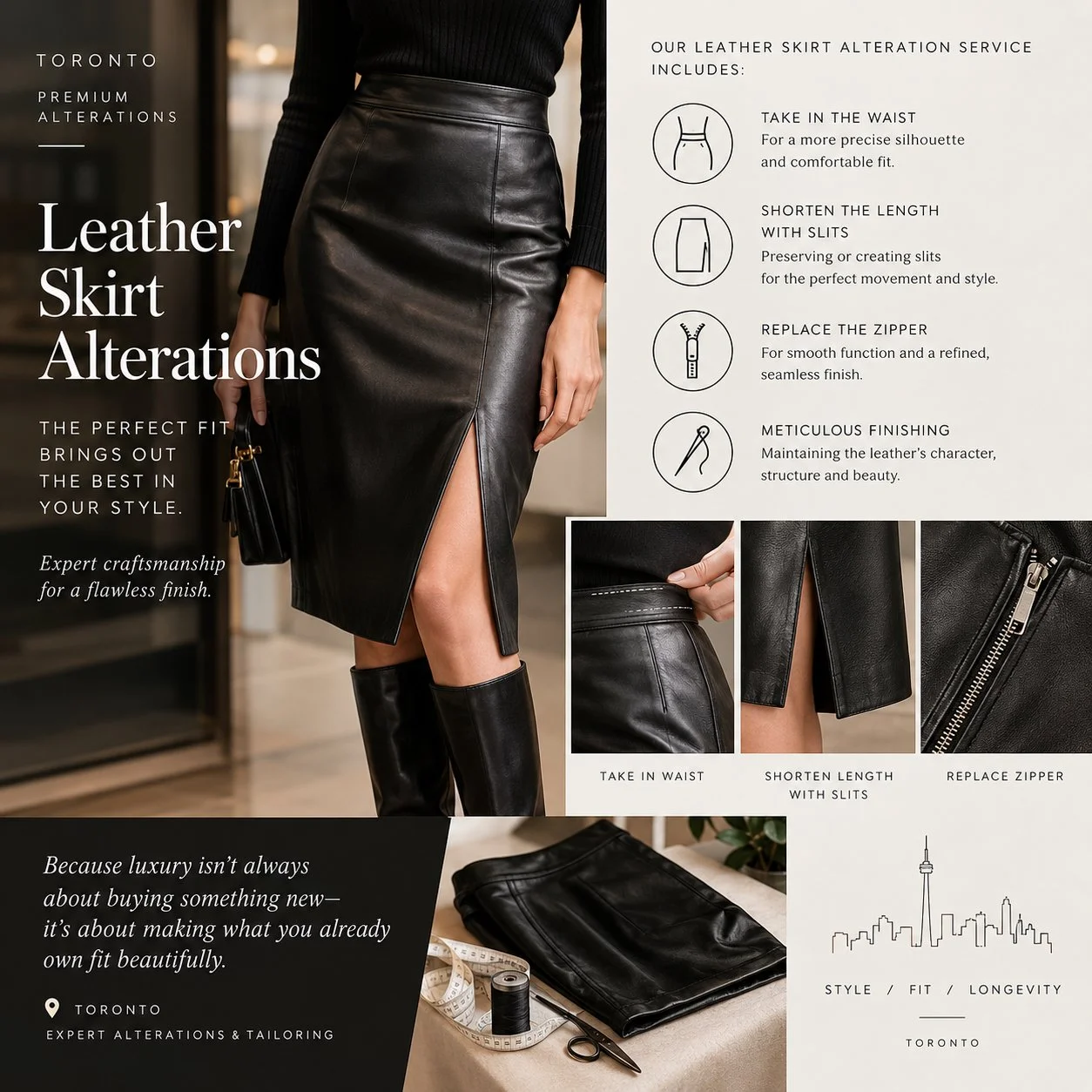
Taking in the waist
The most common request, and the one most often done badly.
The tempting approach is to pinch in the two side seams and call it finished. On a simple skirt that sometimes works. On a well-made leather skirt it usually doesn't, because the waist is rarely the only thing that changes when you remove width. Panels shift off centre. Pockets migrate toward the front. Darts stop pointing where the body actually is. And the grain and tonal variation across a hide — every panel cut from a slightly different part of the skin — stops reading as deliberate.
The better approach is to decide where the width should come out: distributed across several seams, taken through the centre back, redistributed through existing darts, or some combination, depending on how the skirt was built and where your body differs from the pattern. That decision is made on you, standing, in a fitting — not flat on a table. It also means opening the waistband and the lining and closing them again so that nothing reads as repaired.
One honest limit: leather can only be taken in so far before the panel proportions stop making sense. A skirt two sizes too big is often a beautiful alteration. Four sizes is sometimes a conversation about whether the piece should be recut into something else entirely. We'd rather tell you that at the consultation than after.
Shortening the length, and adding slits
Leather doesn't fray, which makes hemming both simpler and less forgiving. There's no rolled, turned, twice-pressed hem doing the work of hiding a raw edge. A shortened leather skirt is genuinely re-cut, and the new edge is finished deliberately — glued and topstitched, faced, bound, or left clean-cut — chosen to match how the original was made. The lining is shortened separately so it hangs correctly and never peeks.
Slits are where craft shows most plainly. A slit is not a cut; it's a constructed opening. The top of the slit — the apex — absorbs every bit of stress from walking, sitting, driving and stairs, and leather concentrates that stress at exactly the point where the material ends. Without reinforcement and a proper facing at that apex, a slit will eventually tear, and a tear in leather does not repair invisibly.
Done properly, the slit is faced, reinforced at the apex, and topstitched for stability, so it opens cleanly when you move and lies closed when you stand. Placement matters as much as construction: a centre back slit, two side slits and a front slit each read completely differently, and each changes how much the skirt will actually be worn. Bring your usual shoes to the fitting. Hem length on leather is decided against real footwear, not an estimate.
Replacing the zipper
A failed zipper is the single most common reason a leather garment is retired, and it is very close to the least serious thing that can go wrong with one. The hide is usually perfect. A component wore out.
The work has two halves. The first is matching: tape weight, coil or metal, tooth size, slider style, and hardware finish. A brass-hardware skirt fitted with a nickel zipper looks wrong even to people who couldn't say why. The second is the setting. Existing stitch holes are already in the leather, so the new zipper is set back along the original stitch line wherever possible — which demands precision, a leather needle, and a walking or Teflon foot that moves the hide evenly instead of dragging one layer against the other.
Done well, a replaced zipper is not a visible repair. It reads as the way the garment was made.
The case for altering rather than replacing
There's a practical argument and a less practical one.
The practical one: a leather garment represents an enormous amount of embodied material and labour. Altering it costs a fraction of replacing it with something of comparable quality, and the quality of mass-market leather has not moved in your favour. Tailoring is the cheapest way most people will ever access clothes that genuinely fit.
The less practical one, which is usually the real reason people walk in: the skirt belonged to someone. Or it belonged to a version of you worth keeping on good terms with. Altering a garment is one of the few ways to carry an object forward without pretending nothing has changed. The zipper is new. The hem is shorter. It's still the same skirt.
This applies well beyond skirts, and well beyond any one wardrobe. Leather jackets, trousers, coats and bags come through the same bench and answer to the same rules — sleeves shortened, jackets taken in through the body, linings rebuilt, hardware replaced. If it's leather and it's well made, the starting assumption should be that it can be saved.
What a fitting consultation looks like
Book one before committing to anything. It's a conversation, not a transaction.
We'll look at the hide itself — weight, finish, suede or smooth, how it's held up, where it's stretched with wear. We'll fit the garment on you rather than guess from measurements. We'll tell you what the leather will allow, what it won't, and where we'd advise against an alteration because the result wouldn't be worth what it costs. Then you'll get the scope, the timeline and the price before any work begins.
Bring the garment. Bring the shoes you'd wear with it. Bring the piece you're not sure is fixable, too — that's frequently the interesting one.
📍 Contact Us
📞 Phone: (416) 967-1845
📧 Email: hello@eliesalterations.com
📍 Address: 2449 Yonge Street, 2nd Floor - unit 1
📱 DM us on Instagram: @eliesalterations